Delayed Coking Filtration Solutions for Refineries
Support delayed coking operations with filtration and separation solutions designed to help control particulate contamination and free water in refinery process stream
What Is Delayed Coking in Refining?
Delayed coking is a refining process used to convert heavy residual oils into lighter hydrocarbon products and petroleum coke. In a delayed coker unit, heated feed enters coke drums where thermal cracking occurs before hydrocarbon streams are separated in a fractionator. Filtration and separation technologies can help manage particulate contamination and free water in delayed coking process streams, supporting product quality requirements and downstream refinery operations.
How the Delayed Coking Process Works
In the delayed coking process, feed is heated to coking temperature in a furnace and then routed to an online coke drum. Larger hydrocarbon molecules are cracked into lighter hydrocarbons, while heavy oils are cracked into lighter hydrocarbons and coke that remains in the drum for later removal.
The cracked hydrocarbon stream is then sent to a fractionator where the different process streams are separated before bottoms are recycled back to the inlet for another pass through the coker.
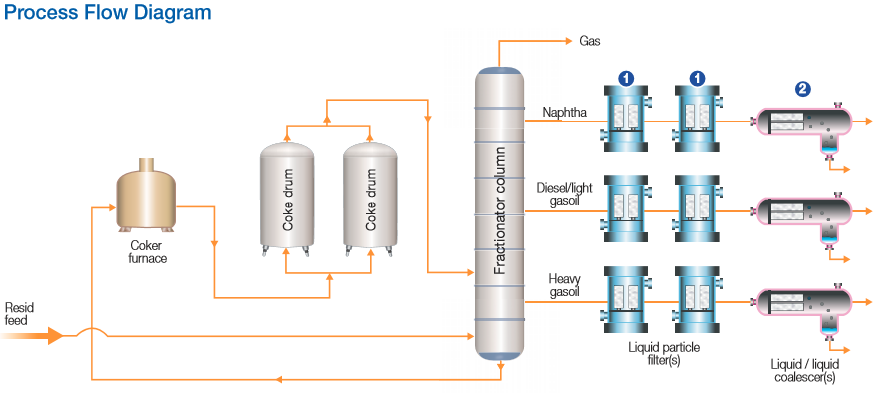
Coking in Refineries Process Flow Diagram
Role of the Fractionator in the Delayed Coking Process
Within the fractionator, coke fines and injected steam can contribute particulate and water contamination to product streams.
Depending on the product, removal of particulate and water may be required to achieve final product quality requirements or prepare streams for downstream processing units such as hydrotreaters.
Key Delayed Coking Filtration Objectives
Refineries commonly focus on:
- Supporting coker unit production targets
- Reducing particulate contamination in product streams
- Managing free water in refinery process streams
- Helping meet product quality specifications
- Protecting downstream processing equipment and operations
Delayed Coking Challenges and Pall Solutions
The delayed coking process can generate particulate contamination and free water challenges at multiple stages. The filtration and separation technologies below are commonly applied to support product quality requirements and downstream operations.
| Challenge | Solution |
|---|---|
Effective Particulate Removal :Achieve daily coker unit production targets. | Meet coker production targets, product quality specifications and downstream unit protection by effective removal of particulate and free water contaminants that are driving fractionates out of specification. |
Particulate Control:Consistently meet particulate and water specification on naphtha and diesel streams headed for final product blending. | For particulate control:
|
Controlling Liquid:Ensure downstream reactor bed protection from delta P build or deactivation due to solids fouling or water contamination. | For liquids control:
|
Recommended Filtration Solutions for Delayed Coking Applications
| Application | Pall Product | Customer Benefits |
|---|---|---|
Prefiltration prior to liquid/liquid coalescer | Ultipleat® High Flow filters, or Coreless filters. | Improves the efficiency and life of the liquid/liquid coalescer
Ensures product quality and downstream unit reliability needs are met through effective removal of problematic solids |
Water Removal | AquaSep EL liquid/liquid coalescer | Ensures product quality and downstream unit reliability needs are met through effective removal of problematic free water |
Need Help Selecting a Delayed Coking Filtration Solution?
Contact Pall's filtration specialists to discuss particulate control and liquid/liquid separation requirements for delayed coking operations.
Frequently Asked Questions About Delayed Coking
What is delayed coking?
Delayed coking is a refining process that converts heavy residual oils into lighter hydrocarbon products and petroleum coke through thermal cracking.
What is a delayed coker unit?
A delayed coker unit typically includes a furnace, coke drums and a fractionator used to separate resulting hydrocarbon streams.
Why is filtration important in delayed coking?
Filtration can help manage particulate contamination and free water that may affect product quality requirements or downstream processing operations.
How does particulate contamination affect delayed coking operations?
Particulate contamination can impact product quality and may affect downstream processing units if not effectively controlled.
What filtration technologies are commonly used in delayed coking applications?
Delayed coking operations commonly use particulate filtration and liquid/liquid separation technologies to help manage contaminants within refinery process streams.
What products are produced during delayed coking?
Delayed coking converts heavy residual oils into lighter hydrocarbon products and petroleum coke.
What contaminants are commonly found in delayed coking process streams?
Particulate contamination such as coke fines and free water may be present in delayed coking process streams.
Why is water removal important in delayed coking operations?
Removal of free water can help support product quality requirements and downstream processing operations.
Talk to Pall's filtration specialists about particulate control, liquid/liquid separation and filtration requirements within delayed coking operations.