What Is Hydroprocessing in Refineries?
Hydroprocessing in refineries is a catalytic treatment process used to remove sulfur, nitrogen, oxygen, metals and other contaminants from hydrocarbon streams to improve product quality and protect critical equipment. This page outlines the causes of hydroprocessing unit fouling, the challenges refineries face, and the filtration and coalescer solutions that improve reliability and run length.
Refinery Needs from Hydroprocessing
Refineries rely on hydroprocessing to meet critical production and reliability requirements, including the need to:
- Achieve production quotas for low sulfur gasolines and diesels by reliably hydrotreating straight run and cracked feedstocks that would otherwise become bottlenecks.
- Deliver consistent “clear and bright” transportation fuels that meet product clarity and appearance expectations.
- Prevent unplanned downtime caused by fouling of feed/effluent heat exchangers.
- Avoid catalyst bed differential pressure (ΔP) increases that can shorten run length and force premature shutdowns.
- Maintain catalyst activity over the full campaign, preventing early deactivation that impacts unit throughput and product quality.
- Meet increasingly stringent clean fuel specifications driven by evolving environmental and regulatory requirements.
- Reduce hazy product issues and minimize downstream salt bed loading, avoiding elevated salt costs and unnecessary changeouts.
- Consistently achieve dryness specifications downstream of vacuum dryers and prevent dryer bottlenecking caused by excessive water in the process stream.
Why Do Hydroprocessing Units Experience Fouling and Reliability Problems?
Refineries may experience:
- Catalyst fouling and shortened production cycles
- Difficulty meeting product specifications
- Heat exchanger fouling and increased ΔP
- Compressor fouling and erosion due to liquid/solid carryover
- Water or hydrocarbon contamination entering downstream units
- Increased operating costs and unplanned downtime
- Dryer bottlenecking caused by excessive water
- Hazy product issues that overload salt beds
When contaminants bypass upstream separation, they accumulate in exchangers, catalyst beds, and recycle gas systems, driving fouling, instability and downtime. Targeted filtration and coalescing at key points are essential to prevent these failures.
Challenges & Solutions in Hydroprocessing
| Challenge | Why it Happens | Solution Approach | Typical Technologies | What This Helps Achieve |
|---|---|---|---|---|
| Unscheduled downtime | Solids/liquids bypass feed preparation and foul catalyst; ΔP rises and run length shortens | Tighten upstream solids & liquids removal to stabilise feed quality into the reactor | Depth/pleated high flow filters (e.g., Ultipleat™ High Flow), liquid/liquid coalescers where applicable | Longer campaigns, fewer unplanned interruptions |
| Meeting product specifications | Particulate and water contamination affect reactor/separator performance and final product quality | Improve feed cleanliness and polish downstream streams to maintain spec | High flow filters for solids removal; AquaSep® EL/XS for water removal | Consistent on spec product and stable unit operation |
| Fouling & erosion of compressors | Aerosol and fine liquid/solid carryover in hydrogen recycle gas causes fouling/erosion and trips | High efficiency liquid/gas coalescing to remove aerosols, droplets, and fines | SepraSol™ Plus & Medallion™ HP coalescers; KO pots, mesh pads, cyclonic devices as needed | Reduced fouling, fewer trips, improved compressor reliability |
Expanded solutions
- Unscheduled Downtime: Removing solids and contaminants upstream prevents catalyst fouling, reduces ΔP rise, and stabilizes hydrotreating/hydrocracking run length.
- Meeting Product Specifications: Feed cleanliness directly affects downstream quality. Reducing particulate and water contamination helps maintain required product specifications and equipment performance. Learn more here.
- Fouling & Erosion of Compressors: High efficiency liquid/gas coalescers remove aerosols and particulates to protect rotating equipment. Includes KO pots, mesh pads, cyclonic separators, and high efficiency SepraSol™ Plus and Medallion™ HP coalescers providing 99.99% removal at 0.3 microns and ~1 ppm downstream (per modified ANSI/CAGI 400 test procedures).
Request a quote or explore compatible filtration solutions here.
Hydroprocessing Process Flow Diagram
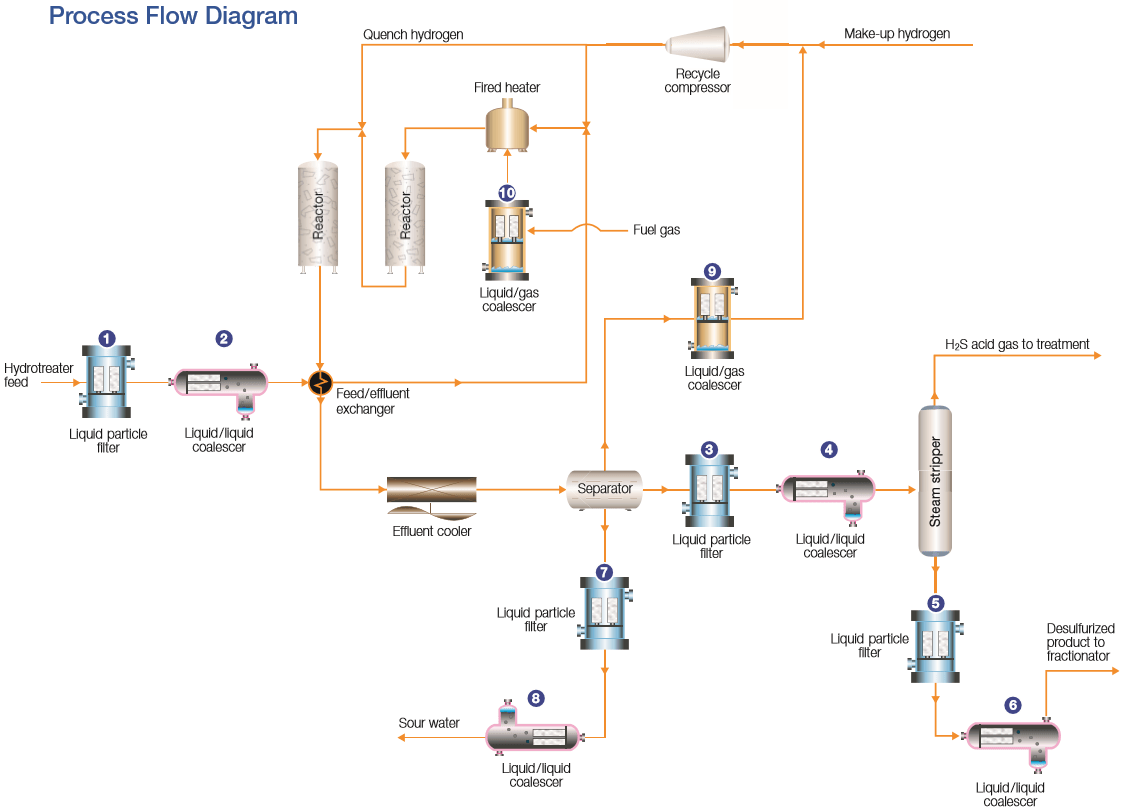
The flow diagram outlines hydrogen circulation, catalyst stages, and separation steps, and shows where contamination enters and where filtration protects equipment. Use the diagram to trace root causes and identify where solids, water, and hydrocarbon removal are required.
Products:
Benefit: Protect hydrotreating catalyst beds; reduce unplanned downtime.
Products:
Benefit: Remove free & emulsified water; prevent catalyst bed damage.
Products:
Benefit: Lower operating costs via longer element life; reduce fouling.
Products:
Benefit: Achieve “clear and bright” final products; improve unit efficiency.
Products:
Benefit: Reduce contamination that leads to stripper/neutralizer corrosion; lower salt bed loading.
Products:
Benefit: Improve compressor reliability; reduce unscheduled downtime.
Products:
Benefit: Reduce turbine/burner fouling; improve stability.
See How Pall Coalescers Work
Liquid/Liquid Coalescers Explained
This video provides an overview of how liquid/liquid coalescers remove water and dispersed phase liquids to protect catalyst beds and downstream equipment.
Liquid/Gas Coalescers Explained
This video demonstrates how liquid/gas coalescers prevent aerosol and liquid carryover in hydrogen recycle and makeup gas streams, helping avoid compressor fouling.
Frequently Asked Questions
What contaminants should be removed in hydroprocessing?
Sulfur, nitrogen, oxygen compounds, metals, water, and particulate solids that reduce catalyst activity and cause fouling upstream or downstream.
Why do compressors foul in hydroprocessing units?
Liquid and solid carryover in the hydrogen recycle gas stream causes erosion and fouling inside compressor internals.
How do coalescers improve reliability?
They remove aerosols, droplets, and fine solids from gas streams to reduce the risk of compressor damage and improve uptime.
Which technologies best extend run length?
High efficiency high flow filters and SepraSol™ Plus / Medallion™ HP coalescers positioned at key contamination ingress points.
-
Hydroprocessing
Download:


Request expert support to improve reliability and performance in your hydroprocessing unit.